The Brown PLT Blog

Articles by tag: Rust
Argus: Interactively Debugging Rust trait Errors
Profiling Programming Language Learning
A Grounded Conceptual Model for Ownership Types in Rust
Practical Static Analysis for Privacy Bugs
Tags: Privacy, Rust, Tools, Verification
Posted on 03 August 2025.Privacy bugs are deeply problematic for software users (“once it’s out there you can’t take it back”), legally significant (due to laws like the GDPR), and difficult for programmers to find and to keep out. Static program analysis would therefore appear to be very helpful here.
Unfortunately, making an effective tool runs into several problems:
-
Rules need to be expressed in a way that is auditable by legal and policy experts, which means they cannot be too close to the level of code.
-
Policies need to then be mapped to the actual code.
-
The analysis needs to be as precise as possible.
-
The analysis needs to also be as quick as possible—ideally, fast enough to integrate into interactive development.
Our new system, Paralegal, checks off all these boxes:
- It supports policies expressed in a first-order logic, but written in a stylized English form. For instance, here is a policy stating that there is a way for all personal data to be deleted:
Somewhere: 1. For each "user data" type marked user_data: A. There is a "source" that produces "user data" where: a. There is a "deleter" marked deletes where: i) "source" goes to "deleter" - It introduces markers as a key abstraction for mapping the policy onto the program. Several of the terms above — e.g.,
user_data— are designated in a lightweight way in the source program:#[paralegal::marker(user_data)] - It deeply leverages Rust’s type system to obtain useful summaries of function behavior without having to traverse their bodies. In particular, this avoids the pain of writing mock versions of functions, which are time-consuming and error-prone, without sacrificing correctness or precision. It also has some additional optimizations, such as adaptive approximation.
As a result, Paralegal is able to efficiently and effectively analyze several third-party, real-world codebases.
For more details, see our paper!
Argus: Interactively Debugging Rust trait Errors
Tags: Rust, Tools, Types, User Studies
Posted on 29 April 2025.Traits are a source of bewildering error messages in the Rust community and people have spent money and time trying to improve the resulting diagnostics. We took a different approach. We analyzed a community suite of difficult-to-debug trait errors and formed hypotheses about why they were difficult for engineers to debug. Then, we built an interactive debugger that developers can use in the IDE to debug trait errors. Find more details about our process, the tool, and our paper in our Cognitive Engineering Lab blog post.
Profiling Programming Language Learning
Tags: Education, Rust, User Studies
Posted on 01 February 2024.Programmers profile programs. They use profiling when they suspect a program is not being as effective (performant) as they would like. Profiling helps them track down what is working well and what needs more work, and how best to use their time to make the program more effective.
Programming language creators want their languages to be adopted. To that end, they create documentation, such as a book or similar written document. These are written with the best of intentions and following the best practices they know of. But are they effective? Are they engaging? How do they know? These are questions very much in the Socio-PLT mould proposed by Meyerovich and Rabkin.
In addition, their goal in writing such documentation is that people learn about their language. But many people do not enjoy a passive reading experience or, even if they do, they won’t learn much from it.
These two issues mesh together well. Books should be more interactive. Books should periodically stop readers and encourage them to think about what they’re reading:
If a listener nods his head when you’re explaining your program, wake him up.
—Alan Perlis
Books should give readers feedback on how well they have been reading so far. And authors should use this information to drive the content of the book.
We have been doing this in our Rust Book experiment. There, the focus was on a single topic: ownership. But in fact we have been doing this across the whole book, and in doing so we have learned a great deal.
-
We analyzed the trajectory of readers and showed that many drop out when faced with difficult language concepts like Rust’s ownership types. This suggests either revising how those concepts are presented, moving them later in the book, or splitting them into two parts, a gentle introduction that retains readers and a more detailed, more technical chapter later in the book once readers are more thoroughly invested.
-
We used both classical test theory and item response theory to analyze the characteristics of quiz questions. We found that better questions are more conceptual in nature, such as asking why a program does not compile versus whether a program compiles.
-
We performed 12 interventions into the book to help readers with difficult questions. We evaluated how well an intervention worked by comparing the performance of readers pre- and post-intervention on the question being targeted.
In other words, the profiler analogy holds: it helps us understand the behavior of “the program” (namely, users going through the book), suggests ways to improve it, and helps us analyze specific attempts at improvement and shows that they are indeed helpful.
However, we did all this with a book for which, over 13 months, 62,526 readers answered questions 1,140,202 times. This is of no help to new languages who might struggle to get more than dozens of users! Therefore, we sampled to simulate how well we would have fared on much smaller subsets of users. We show that for some of our analyses even 100 users would suffice, while others require around a 1000. These numbers—especially 100—are very much attainable for young languages.
Languages are designed for adoption, but mere design is usually insufficient to enable it, as the Socio-PLT paper demonstrated. We hope work along these lines can help language designers get their interesting work into many more hands and minds.
For more details, see the paper. Most of all, you can do this with your materials, too! The library for adding these quizzes is available here.
A Grounded Conceptual Model for Ownership Types in Rust
Tags: Crowdsourcing, Education, Rust, Types, User Studies, Visualization
Posted on 17 September 2023.Rust is establishing itself as the safe alternative to C and C++, making it an essential component for building a future software univers that is correct, reliable, and secure. Rust achieves this in part through the use of a sophisticated type system based on the concept of ownership. Unfortunately, ownership is unfamiliar to most conventionally-trained programmers. Surveys suggest that this central concept is also one of Rust’s most difficult, making it a chokepoint in software progress.
We have spent over a year understanding how ownership is currently taught, in what ways this proves insufficient for programmers, and looked for ways to improve their understanding. When confronted with a program containing an ownership violation, we found that Rust learners could generally predict the surface reason given by the compiler for rejecting the program. However, learners could often could not relate the surface reason to the underlying issues of memory safety and undefined behavior. This lack of understanding caused learners to struggle to idiomatically fix ownership errors.
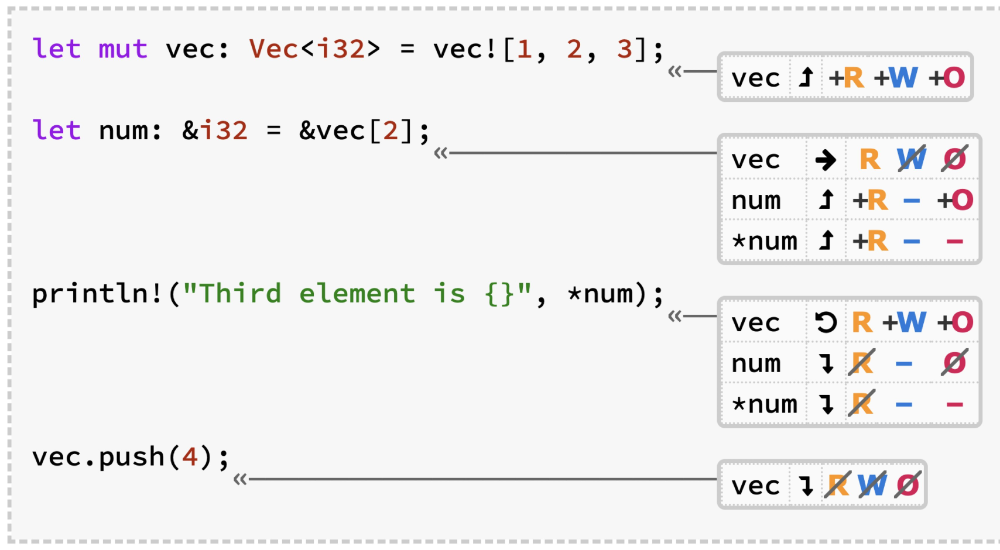
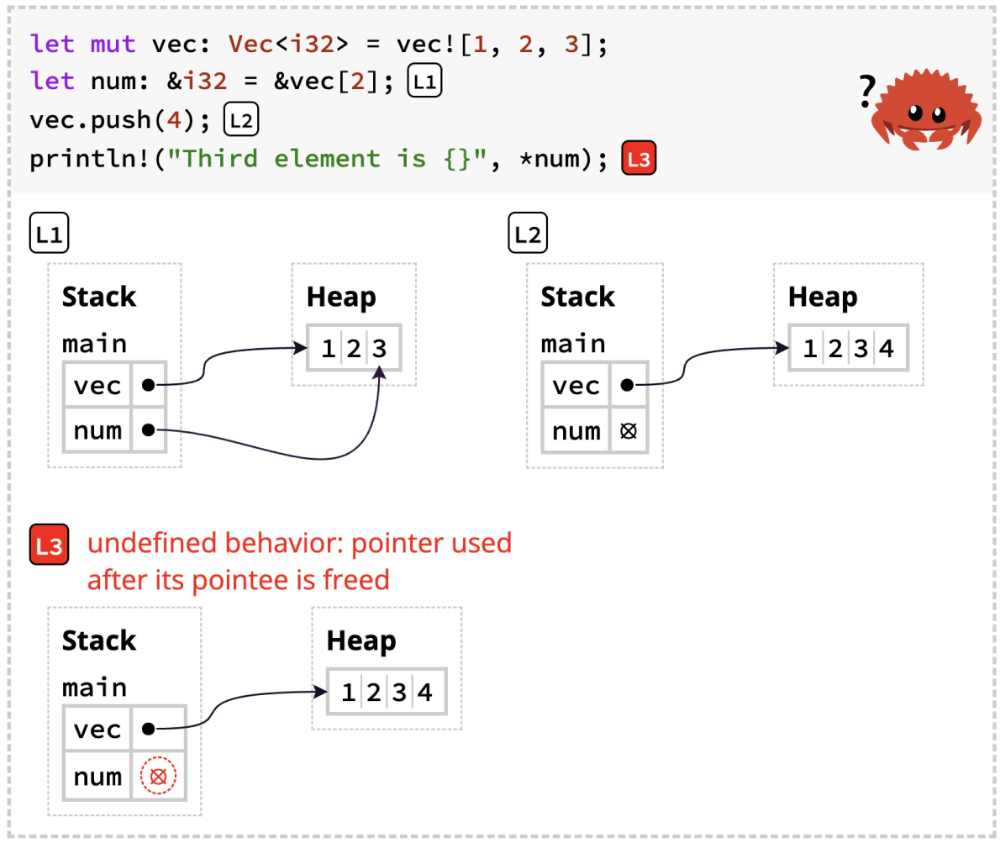
To address this, we created a new conceptual model for Rust ownership, grounded in these studies. We then translated this model into two new visualizations: one to explain how the type-system works, the other to illustrate the impact on run-time behavior. Crucially, we configure the compiler to ignore borrow-checker errors. Through this, we are able to essentially run counterfactuals, and thereby illustrate the ensuing undefined behavior.
Here is an example of the type-system visualization:
And here is an example of the run-time visualization:
We incorporated these diagrams into an experimental version of The Rust Programming Language by Klabnik and Nichols. The authors graciously permitted us to create this fork and publicize it, and also provided a link to it from the official edition. As a result, we were able to test our tools on readers, and demonstrate that they do actually improve Rust learning.
The full details are in the paper. Our view is that the new tools are preliminary, and other researchers may come up with much better, more creative, and more effective versions of them. Rather, the main contribution is an understanding of how programmers do and don’t understand ownership, and in particular its relationship to undefined behavior. It is therefore possible that new pedagogies that make that connection clear may obviate the need for some of these tools entirely.