The Brown PLT Blog

LLMs ⭢ Regular Expressions, Responsibly!
Tags: Large Language Models, Semantics, Tools
Posted on 11 December 2025.This tool is part of a much broader effort to help us use GenAI responsibly. Please see our newer post with details about the broader context.
Do you use GenAI/LLMs to generate your regular expressions? We certainly do! But we always do it with trepidation, given the many slips that can occur with blindly pasting the output into a program. We may have been unclear in our prose, our prose may have been ambiguous, the domain may lend itself to ambiguity (what is a “date”?), the LLM may have misinterpreted what you said, the domain may have persistent misconceptions, and so on.
Oh, you read your regexes, you say? Is this a valid regex for dates?
^(?:(?:31-(?:0[13578]|1[02])-(?:\d{4}))|
   (?:29|30-(?:0[13-9]|1[0-2])-(?:\d{4}))|
   (?:29-02-(?:(?:\d\d(?:0[48]|[2468][048]|[13579][26]))|
              (?:[048]000)))|
   (?:0[1-9]|1\d|2[0-8]-(?:0[1-9]|1[0-2])-(?:\d{4})))
But we can do a lot better! Our new tool, PICK:Regex, does the following. It asks you for a prompt and sends it to a GenAI system. However, it doesn’t ask for one regex; instead, it uses an LLMs ability to interpret prose in multiple ways to generate multiple (about four) candidate expressions. (The details don’t matter, but if you want to you can open the images below in a new tab to read them more easily.)

In theory, that’s better than getting just one interpretation. But now you may have to read four regexes like the above, which is actually worse! Therefore, instead, PICK shows you concrete examples. Furthermore, the examples are carefully chosen to tell apart the regexes. You are then asked to upvote/downvote each example. As you do, you are actually voting on all the candidate regexes.
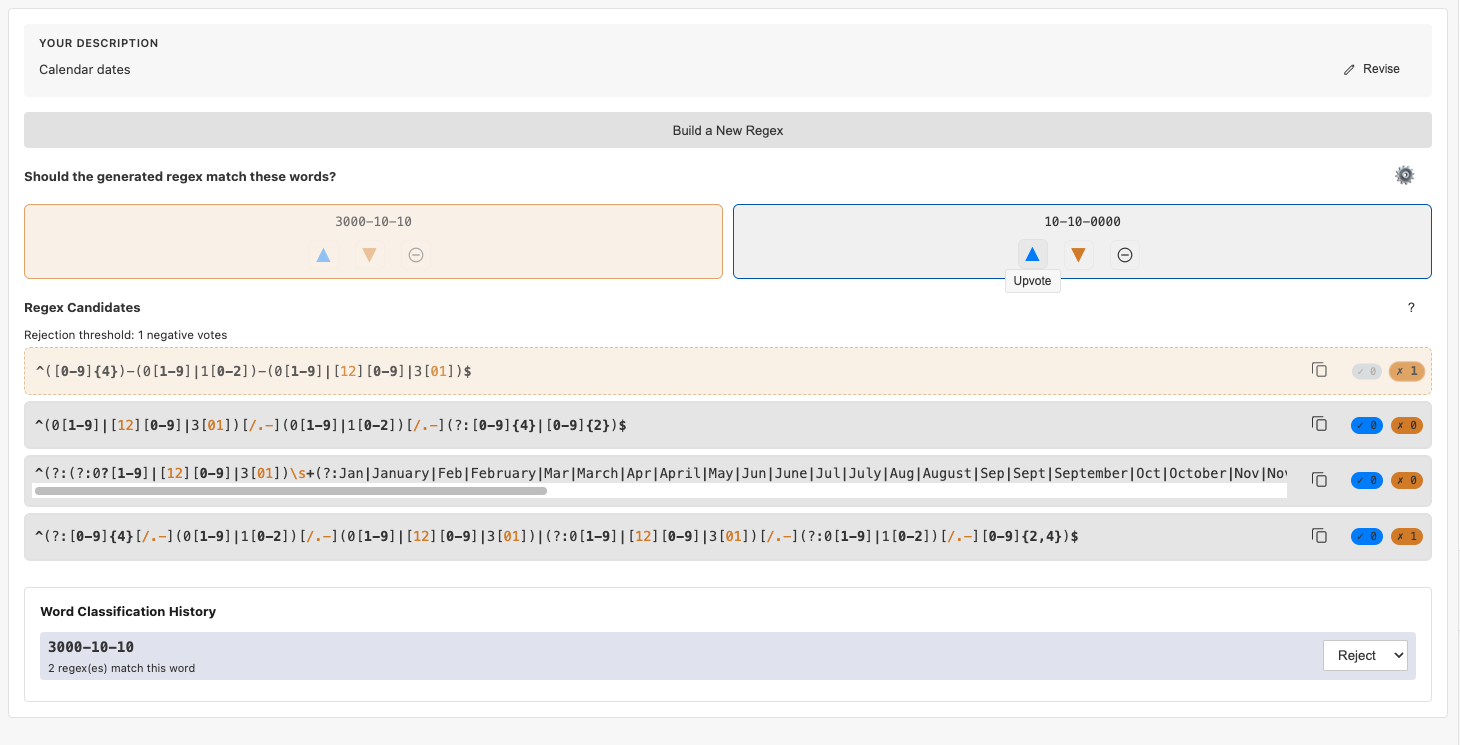
You can stop at any point (you’re always shown the regexes), but the process naturally halts when only one regex remains (this is your best candidate of the ones you’ve seen so far) or none remain (in which case it would have been dangerous to use the LLMs output!).
As you’re looking at examples, you may realize you could have provided a better prompt (or could have used a more expensive LLM). You don’t need to start over; you can revise your request. This generates regexes afresh, but critically, you don’t lose your hard work: your prior upvotes and downvotes are automatically applied to the new proposed regexes.
Also as you’re looking at examples, you might come up with some good ones of your own. You can type these into PICK and vote on them (i.e., provide both positive and negative examples), and PICK will add them to the example stream. Similarly, you can edit an example PICK has shown you before voting on it.
Finally, you can also change your mind. PICK shows you all your prior classifications at the bottom. If you change how you classified an example, that will update the scores of all the candidates.
PICK is based on the confluence of two very different bodies of ideas. It draws from cognitive science: the idea of understanding the abstract through the concrete, and the theory of contrasting cases. It also puts to work all the formal language closure properties you studied in a theory of computation class and wondered why and when they would ever be useful.
Enough prose! Please try PICK for yourself. It’s available as an extension from the Visual Studio Code Marketplace (it uses your VSCode LLM configuration). Visit this link, or search for SiddharthaPrasad.pick-regex in the Marketplace. If you don’t have a ready question, try a prompt like “countries of North America”—but before you do, what regex are you expecting? Think about it for a moment, then see what PICK offers you. Let us know what you think!